Saturday, February 17, 2018
Garden Revolution by Larry Eaner and Thomas Christopher
I am still reading gardening books but I may soon stop as I would have to get more to read. However, we just started tapping the sugar maples at Maple Grove Farm, where I live, then I may go on a vacation and start back at the nursery.
I took so many notes on Garden Revolution that I can't tell you all of them but this is one of the best books on "natural landscapes" that I have read. It has alot of philosophical material but also lots of practical suggestions and examples. Natural Gardens change with time is an important maxim. There is quite a bit about Frank Egler who did alot to get the natural gardening "movement" started. He said "Nature is not more complex than we think, but more complex than we can think. Too outspoken and argumentative for academia, he "retired" to his family's 500 acre estate in Norfolk, CT, Aton Forest, where he put his principles into play.
These are just a few tidbits:
Brush hogging in August favors cool season grasses whereas June mowing favors more desirable grasses such as little blue stem.
Keep a shrub area by curring trees and hand applying roundup.
Having mother colonies of plants which self seed often works better than seeding.
Fertilizing, applying compost and watering can lead to invasive weeds.
Don't worry about color clashes in a meadow.
Cut rather than pull weeds if there is a dense ground cover.
Tilling is usually a mistake. It is alot easier to establish a meadow in old pasture than in a previously tilled or disturbed area.
Chipped wood is often better than mulch as the mulch adds nutrients which leads to weeds.
Before clearing large areas, do smaller test runs.
I don't have time to write everything I gleaned down now. There is step by step guide to creating a meadow.


Sunday, February 11, 2018
Hellebores, the Gardener's Guide to Growing by Graham Rice and Elizabeth Strangman
I may discontinue these book reports but I am still into it for the time being. I have been reading 3 books suggested to me by a young English plantsman-this is the last of those. Also, I have been reading several books about "natural" gardening where the idea is to have flowers in meadows instead of "gardens"-this is not one of those.
This is a very thorough and carefully researched book about the taxonomy and culture of hellebores. It was written 25 years ago in England so it lacks up to date information about hellebore growers in the US.
Those with outward or upward facing flowers may not be so good in the UK with so much rain but I prefer them as they seem to show up the best in the garden. It turns out that the hybrids most commonly available are not H. niger x H.orientalis as I thought as those 2 species do not cross readily. Mentioned in passing is something a young English plantsman, Sam Pagett, told me: seedings are much more vigorous than clones from divisions which is why so many available are strains.
Personally, I thinks Christmas rose, H.niger, is the hardiest up here but many of the "x hybridus" hellebores make it. I don't think H.foetidus is hardy here which is too bad.
Many people are becoming addicted to Helleborus.
Sunday, February 4, 2018
Juice with no added sugar
This last year, all the juices I canned were sugar free. My doctor told me my blood sugar level was so high as be almost diabetic, so now I use no sugar. I have found sugarless fruit juices to be quite palatable-although it took me a while to get used to them and some such as cranberry juice and black currant juice really are just too sour.
Including crabapple juice makes a big difference, especially Dolgo crabapple. Our blackberry/ Whitney crabapple juice is excellent and most of the very tart berries mixed with crabapple are good. Sadly, the two spotted fruitfly ruins alot of these berries and the Dolgo crabapples.
The Living Landscape: Designing for beauty and biodiversity in the home garden by Rick Darke and Doug Tallamy
I bought this book at a "New England Grows" plant conference in Boston a year or two ago and just finished reading it. The basic idea is that normal suburban yards can be designed very easily to be better for the ecosystem. Rick Darke's photographs are excellent and the writing is very readable. Besides plants; birds and insects are heavily featured. I don't know how much longer I am going to do these book reports.
These are a few of the ideas I got from the book: Alot of deer and you end up with alot of spice bush and ferns which they don't eat so much. In much of our are, when there is a tornado say which causes a bare opening, alot of invasive bushes and vines come in. In Florida where the native cycad, Zamia pumila, was largely harvested in the wild for food, the Atala butterfly disappeared completely and was considered to be extinct. However, it was then used widely in peoples yards and the butterfly returned (it needs that cycad to eat). The more species of caterpillars, the more species of birds. Boxturtles are the main dispersal agent for mayapple seeds.
Here are a few maxims I got:
Our goal is to reduce the introduction of rapid environmental changes causing extinctions to occur faster than new species can evolve.
Ecosystem function increases directly with the number of species.
You can use all natives some of the time, some natives all of the time, but not all natives all of the time.
Wednesday, January 31, 2018
Winter Reading: Color for Adventurous Gardners by Christopher Lloyd
I am still trying to do so some reading of quality gardening/plant books this winter. This is the third book I have read by Christopher Lloyd who has a wonderful sense of humour. Color for Adventurous gardners goes through each color flowers can be, describing his favorite in each. It includes mauve, green, brown, and black.
His basic tenet is that one doesn't have to worry about color clashes in the garden but maybe he just has an inborn sense of good taste. He says, "In our adventurous borders, the loudest reds and oranges, with which it contrasts so tellingly, can be let loose given green as a safety net." In the very latest issue of the English Garden Magazine, there is a quote from Dr. Jimmy Smart, creator of Marwood Hill Gardrens, in Devon (England): "One never really notices clashing colour in the wild and there are very few occasions when it offends me in the garden." This is the same idea.
Lloyd doesn't seem to be a fan of Monarda- one would expect it in the chapter on red. Also, Hemerocallis are not used alot- I would have expected them in the chapter on orange flowers. In his chapter on white flowers, he warns not to use huge expanses of blaring white. His chapter on mauve is interesting: mauve is a color many think they don't like. Magenta, another comtroversial color is included in the chapter on purple flowers. Purple, magenta and mauve run into each other and seem to mean different things to different people- they run into blue and pink also. The only color he discusses which I have not just mentioned is yellow which also scares people. Lloyd is not a timid flower colorist.
Sunday, January 28, 2018
The Well Tempered Garden by Christopher Lloyd
This is a classic of gardening literature and at least for mee took some time to read- especially as I needed to look up many plants which don't grow here or even in Philadelphia. The book is filled with tons of information and alot of humor, often of a slightly snide type which I love. He writes about propagation, planting techniques, garden design, cultivars of many plants all from years ans years of personal experience. I started marking passages I wanted to mention but don't have time now to do so.
A few examples: He has a discussion of sea buckthorn for seaside planting, he talks about using Polygonaum cuspidata as an ornamental,he mentions a controversy about planting Japanese iris in a pond,he talks about pruning the top portion of a plant when transplanting, what about Forsythias?, he questions peonies being easy to grow and what about peony rings, he cautions about planting in even lines. Those are what I noted in 50 pages of a 450 page book.
Friday, January 5, 2018
Christopher Lloyd's Meadows
I am hoping to do more reading of excellent plant books this winter. The first one I just finished last night is Meadows by Christopher Lloyd. I have noticed from plant conferences which I have attended, customers at the nursery, and landscape jobs which our nursery is involved with, that more and more people are attracted to the idea of "meadows". They want areas with more biodiversity for insects (pollinators), birds, and mammals. Also they don't want to "waste" quite so much time mowing and people are growing to prefer a wilder more natural look for their yards. However, creating a meadow or a meadow/prairie garden is not as easy as one might think and hope. Christopher Lloyd describes his meadow gardening with alot of humour and excellent photographs.
Tuesday, September 5, 2017
Seaberry or Hippophae rhamnoides
Last year we had enough seaberries to make some juice and as it tasted terrible by itself I decided to mix it with blackberry to make a juice. It was the worst juice I had ever made (of course, we drank it all anyway). This year I didn't get the seaberries harvested before they started to go bad on the bushes-i.e.rot. We harvested them anyway and made a juice with about a quart of seaberries and 2 gallons or so of Dolgo crabapples. It's delicious or at least not too bad. I like it. We pruned the Hippophae to about 10 feet so it could be easier to pick next time. They spread by under ground stolons coming up as far as several feet away from their parents and transplant readily.
So far this year we have made black currant, gooseberry, wild cherry, blackberry, and crabapple juice: all with no sugar.
Thursday, November 10, 2016
Foliage and Berries
This September and especially October were about the best we ever had for fall foliage. I think of October for leaves and then November for berries.

 I have been using Euonymus europaeus and Ilex verticillata and Celastris orbiculatus berries. These are the "flowers" I have done recently for the West Newbury Church.


Wednesday, September 28, 2016
Last Batch of Juice for the Season
I canned about 10 gallons of juice last night. I still plan to make cider but I have to freeze it as canning ruins it. I made a couple gallons of Schizandra- Aronia with a tiny bit of Dolgo crabapple thrown in. Also, I made my grapes into juice as we've had two light frosts and once the grapes freeze, they are no good for anything--I've tried to juice them after they freeze and no-go.
Tuesday, September 20, 2016
Martha's Vineyard Vacation
We're spending 10 days on Martha's Vineyard visiting our daughter, Kady. I've volunteered 2 days at the Polly Hill Arboretum where she works; raking leaves (I learned a new excellent 3 person method of picking up leaves after they are raked into a pile: I might be able to convert it to a one person method}, planting Clethra (they are embarking on a Clethra evaluation project: we transplanted 'Ruby Spice', and fencing plants against deer. They have a wonderful collection of oaks at the Polly Hill
 The Franklinia is in bloom there
 We are going to be here 2 more days: I'm sketching the ocean a lot.


Tuesday, August 30, 2016
Elderberry Crop Failure
This year many if no most of my elderberries fell off the bushes just before they were dead ripe. I think it was due to dryness. First I thought it was birds eating them even though I did put nets over them, sort of,.... (it wasn't a very good netting job). However there were lots of little - not quite ripe- elderberries all over the ground. I checked the berries for fruit fly maggots and didn't see any, although 2 farms near me had fruit flies ruining their blueberries. I did make one batch of crabapple-elderberry juice which I plan to can tonight.
I still plan to make aronia-schizandra juice and grape juice.
Saturday, August 27, 2016
Making Juice and Cider
I've been making juices this year with no sugar or other sweetener as i"m now pre-diabetic. Gooseberry and crabapple are quite good the different juices I have made with blackberries are not as good as with sugar. I haven't given up though. I still have elderberries to harvest although they are been ruined by birds and I still plan to make grape juice when my grapes are ready.
I made excellent cider last week using Duchess apples and Whitney crabapples which previously I had let all rot.
Tuesday, August 9, 2016
Sea Buckthorn, Seaberry, or Hippophae rhamnoides
We harvested my sea buckthorn yesterday: they were soft and I guess ripe. They are one of the worst of all thorny fruit to pick: they don't come off the stems easily and the hawthorn-like thorns (little spur branchlets) are wicked. Also, they are downright sour with a tangerine-like smell. I made juice, combining them with blackberries which is one of the worst tasting juices I have made yet. It doesn't help that I put no sugar in. I'll see later about canning the stuff- tonight I'm going to Tosca and my wife Dana is having possibly severe car problems in Templeton, Mass.
Monday, August 8, 2016
Diabetic Juice and Shin-Boku Nursery
I've already harvested my gooseberries and black and red currants and made them into juice with no sugar and canned that. With the black currants, I made the pulp remaining in the jelly bags into diabetic jam by running it through a foley food mill and adding stevia, to one batch and splenda to another: the splenda tastes better to me. I used "no sugar needed" pectin. I seem to have developed "pre-diabetes". I'm drinking the juice with no sugar and it's not too bad, especially the gooseberry. Now, my blackberries are in and I want to make some into juice adding seaberry and/or Dolgo crabapple. So far, I've frozen the berries.
I visited Shin-Boku nursery in Wentworth, NH on Saturday, after work at the nursery. Palmer Koelb has amazing huge trees pruning in the "Japanese style" : they look like full-size bonsai specimens.


 Palmer Koelb also has a Japanese "Stroll Garden" open to the public any time which incorporates a lot of magnificent specimens of carefully pruned evergreens and some deciduous plants such as Enkianthus and a Stewartia and some summer-blooming deciduous azaleas.


Sunday, July 17, 2016
Hemerocallis Breeding
For the last several years, as the result of an article in a gardening magazine, I have been toying with making crosses of my two favorite daylilies which are 'Alabama Jubilee'which is red orange ruffly tet and 'Tuscawilla Tigress'which is a medium orange tet with a prominant yellow stripe.
 I have taken pollen from one
  and put it on the stigma of the other. Then I grew the seedlings for a couple of years and this is the result: 'Kady'
Now I am trying to breed for very tall daylilies: after reading the recent article in 'Horticulture' magazine about Ollalie Daylily farm in Newfane, VT. The pictured 'Towers of Eisenkramer'which was both out of stock, according to their website, and cost $150.00. So I'm tring to breed my own with Hemerocallis citrina Vesperitina as the pod parent and 'Ophir' and an unnamed tall yellow as the pollen (sperm) donor. Hope I succeed.
and put it on the stigma of the other. Then I grew the seedlings for a couple of years and this is the result: 'Kady'
Now I am trying to breed for very tall daylilies: after reading the recent article in 'Horticulture' magazine about Ollalie Daylily farm in Newfane, VT. The pictured 'Towers of Eisenkramer'which was both out of stock, according to their website, and cost $150.00. So I'm tring to breed my own with Hemerocallis citrina Vesperitina as the pod parent and 'Ophir' and an unnamed tall yellow as the pollen (sperm) donor. Hope I succeed.

 I have taken pollen from one
Friday, June 17, 2016
Itoh Hybrid Peonies
This is the season for poppi es and peonies: roses are just starting.
I've become increasingly interested in the Itoh Hybrids( between herbaceous and tree peonies}. The are very good growers, come in wonderful colors -like tree peonies and have the same interesting foliage as tree peonies do. I unfortunately just noticed that rose chafers like them also.
es and peonies: roses are just starting.
I've become increasingly interested in the Itoh Hybrids( between herbaceous and tree peonies}. The are very good growers, come in wonderful colors -like tree peonies and have the same interesting foliage as tree peonies do. I unfortunately just noticed that rose chafers like them also.


Wednesday, June 8, 2016
Lilacs and Poppies
Our Lilac Tea was quite successful and well attended. It acted as if it might rain but the rains held off, although there were some bugs. The lilacs were at their peak - the next week they weren't quite as good and the following Sunday it poured rain. The masses of orange poppies didn't come till the next week- nor were the orange Mandarin Light deciduous azaleas out. The iris were maybe at their peak yesterday but the hail last night might have ruined them somewhat. Now the roses and peonies are coming. By the way the peonies in bloom during the tea were Athena and Claire de Lune. In the last 2 weeks, I've been attempting to get the labeling corrected on my lilacs- I've done pretty well.


 The next day after the Lilac Tea, Kady and I went for a walk up Urquhart road looking at the Polygala and pink ladyslippers and the blossoms of Acer spicatum and Acer pensylvanicum.


Wednesday, May 25, 2016
Lilac Tea
My annual lilac tea is happening this coming Sunday at four in the afternoon.


 It looks like they could be out in time although the season is somewhat behind where it usually is. I'm busy getting ready for it: weeding, mowing not to mention baking. Both Kady and Libby are going to be here this year. My lilacs were excellent last year and some how there was alot of dead this spring which we have tried to prune out--I figured this would be a good year for a more drastic pruning anyway.
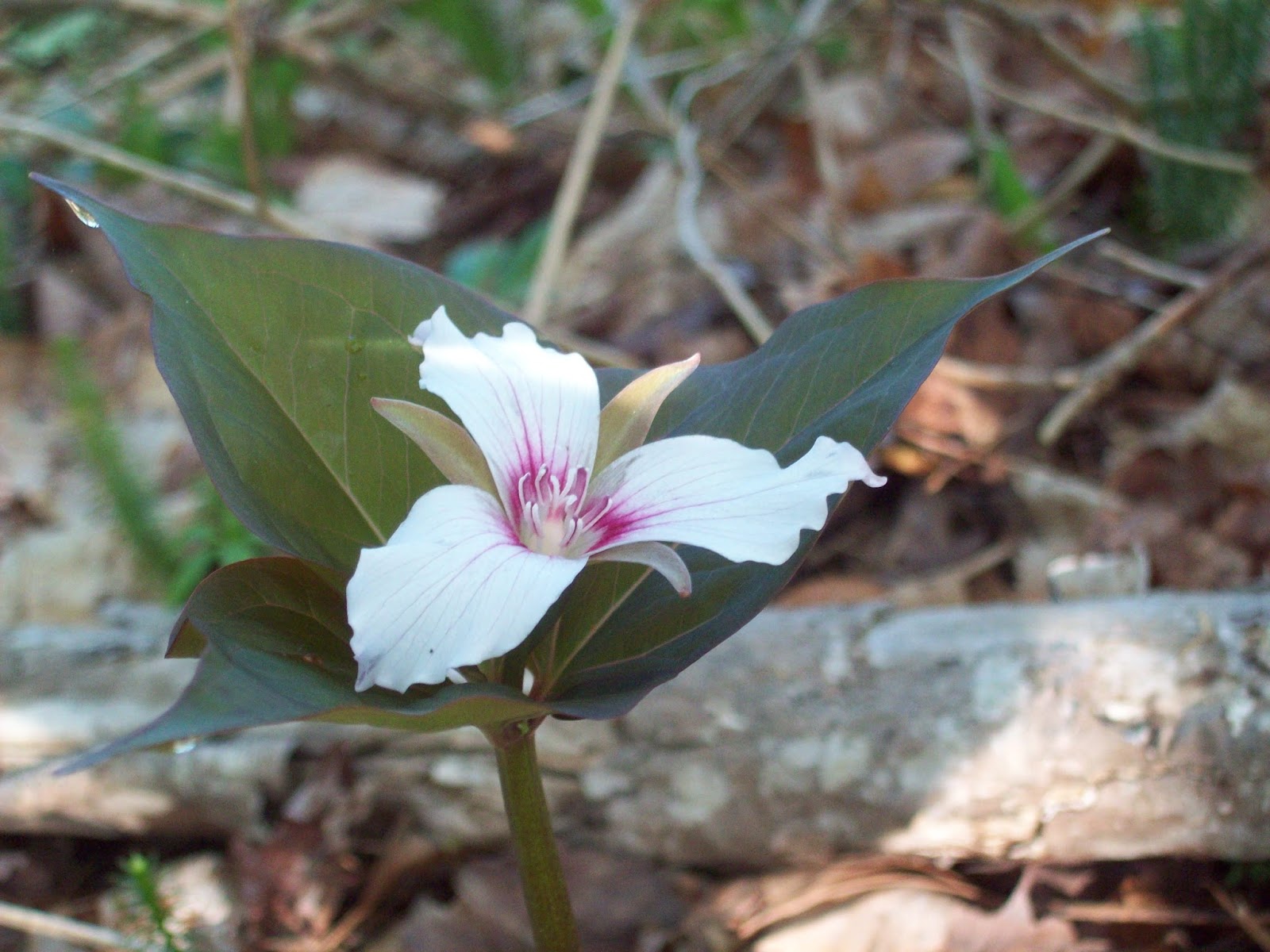
On another note, I found and photographed some painted Trillium growing here in West Newbury
It looks like they could be out in time although the season is somewhat behind where it usually is. I'm busy getting ready for it: weeding, mowing not to mention baking. Both Kady and Libby are going to be here this year. My lilacs were excellent last year and some how there was alot of dead this spring which we have tried to prune out--I figured this would be a good year for a more drastic pruning anyway.
On another note, I found and photographed some painted Trillium growing here in West Newbury




Tuesday, May 10, 2016
Daffodil Walk Reviewed
My Narcissus are just coming into it now. Some are not out yet but almost none are gone by. Now or even next weekend would be perfect for the Daffodil party we had just over a week ago on May 1st.
One could say we had the worst daffodil year we've ever had. Luckily I have a lot of them so that losing a few thousand isn't as noticeable. First after coming on early, we had 2 consecutive nights of 4 degrees: that killed a lot of flower buds and ruined some foliage, then we had the snow storm which flattened them. The final two blows were several weeks of unseasonably cold weather which set them back and of coarse, it rained for our walk. Other than that it was perfect.
Subscribe to:
Posts (Atom)